


Election insights: Analysing Senedd polling through data modelling
25th March 2026
Reform UK has the potential to become the largest party in the Senedd following May’s election, according to new probabilistic modelling of Welsh polling data.
However, analysis by Cardiff-based communications agency Grasshopper suggests eight seats are too close to call in a highly contested result that sees no party coming close to a majority.
As reflected in recent polling, Plaid Cymru and Reform UK are projected to emerge as the two dominant parties.
Despite this, it would take significantly less votes for Reform UK to be the biggest party in the Senedd, than it would do for Plaid Cymru to be the biggest.
Key findings
- Reform UK and Plaid Cymru set to be the two largest parties
- Greens go head-to-head with Reform UK for sixth MS in multiple constituencies
- Labour support is steady but limited, leaving one MS per constituency
- Liberal Democrats to win two seats despite low vote share
- Conservatives on course to lose all Senedd Members
Uncertainty
Grasshopper’s analysis, which harnesses Monte Carlo simulation modelling to estimate outcomes across all 16 of the new Senedd constituencies, aggregates polling data rather than relying on individual surveys.
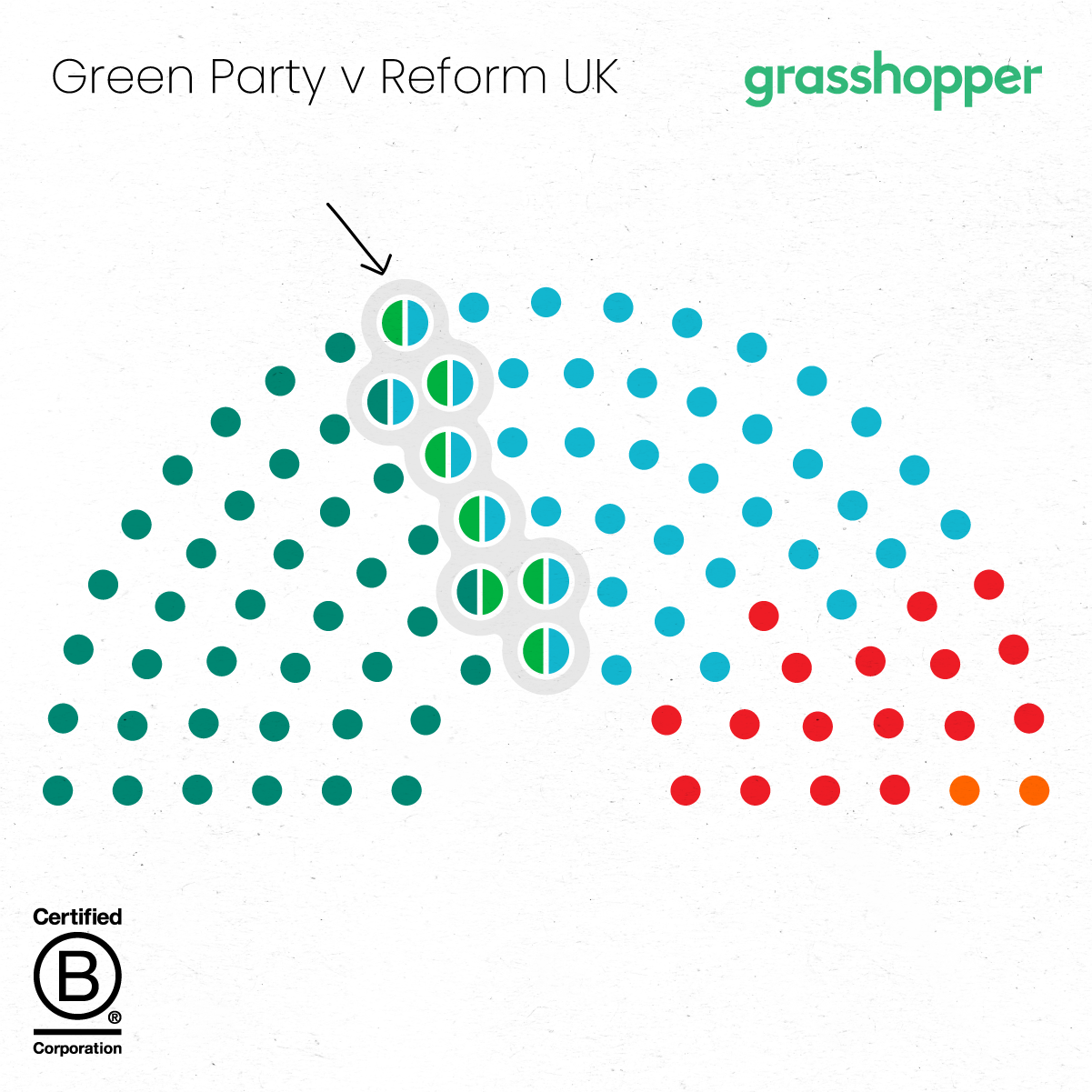
The findings show that multiple constituencies remain highly competitive, particularly for the final (sixth) MS.
It is the Greens that are in contention for the final seat in seven constituencies, going head-to-head with Reform UK in six of them.
Reform’s consistency v Plaid’s strong voter concentration
Head of Corporate Affairs Craig Lawton said: “We are seeing Reform UK’s support spread relatively evenly across Wales. This puts them in a strong position to convert votes into seats and suggests their reliance on a simple and consistent message – led by Nigel Farage across UK media – is working.
“Plaid Cymru, while polling strongly overall, are still relying more heavily on concentrated pockets of support. This could put them at a disadvantage as they could arguably see votes ‘wasted’ in their strongest areas.”

Craig Lawton
Conservatives collapse v Lib Dem efficiency
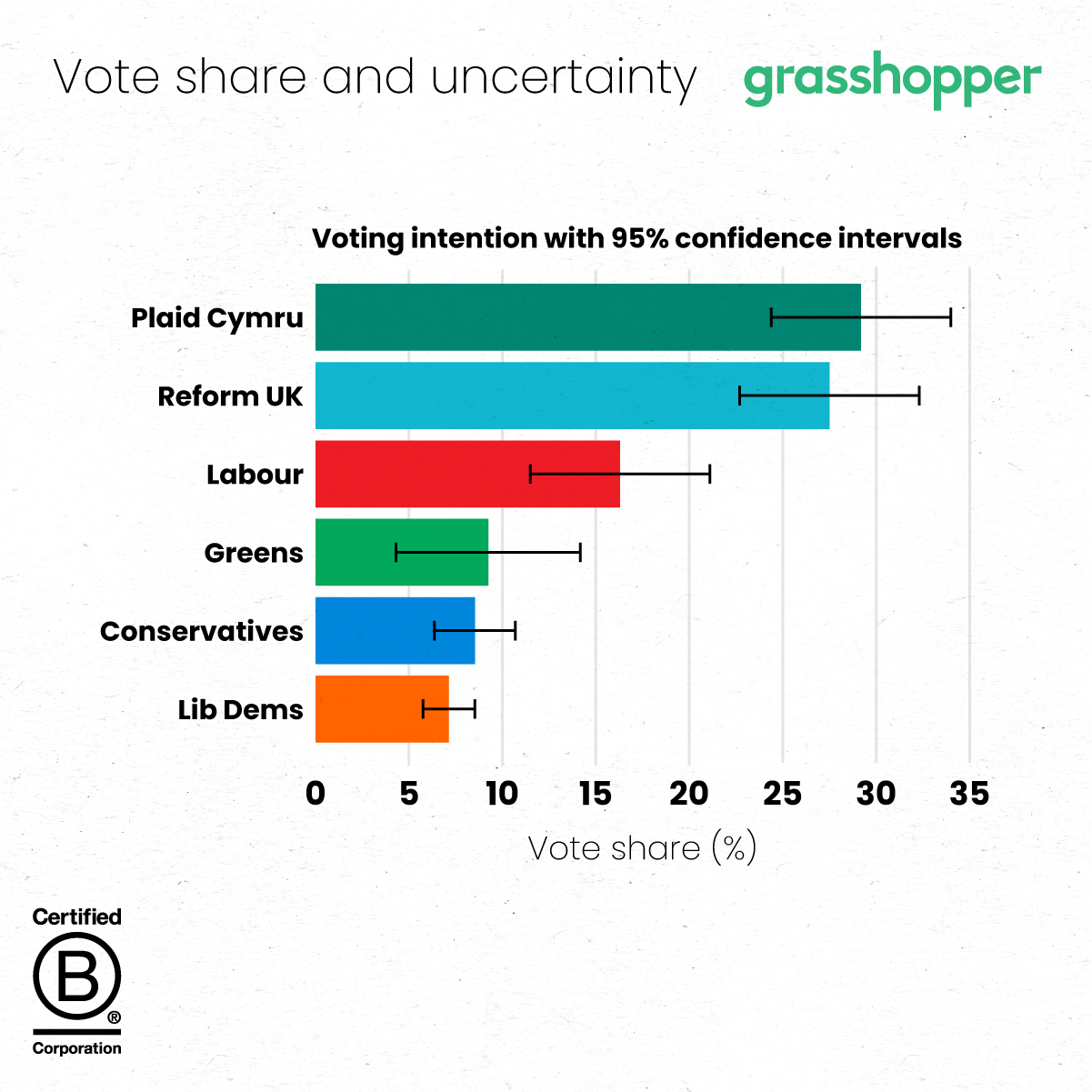
Despite polling at an average of 8.7%, the Conservatives are projected to win no seats at all under the new voting system. This is due to a relatively thin vote distribution across most of Wales.
“The Lib Dems have become known for their hyper-local campaigning, and it looks set to benefit them once more,” added Craig Lawton.
Labour’s stability
Despite a significant drop in polling since the 2021 Senedd election, Labour’s vote share appears relatively consistent across Wales, at 16%.
This is translated into an estimated 16 seats, suggesting the party could still win one MS in every constituency.
“Despite Ceredigion Penfro remaining one of Labour’s weaker areas, this data suggests current First Minister Eluned Morgan can still hang on to her seat in the Senedd,” said Craig Lawton.
Probabilistic modelling explained
Grasshopper’s Head of Research and Insights, Dr Andy Cotter-Roberts, said: “Polling in Wales currently shows huge variation between polls and polling companies.
“By combining all this data into Grasshopper’s own purpose built probabilistic model, we are able to understand the range of possible outcomes and see the extent of the uncertainty, rather than relying on any single poll.
“This gives us a far more robust model and a much better picture of what the result could be.
“However, the greatest part of the uncertainty is the decline in the Labour vote and where that lands, with Plaid, Reform UK and the Greens being the potential beneficiaries.”

Dr Andy Cotter-Roberts
Current projections give some certainty
In 95% of all simulations run through Grasshopper’s specialist model, current projections suggest parties will secure the following minimum number of Senedd Members:
- Plaid Cymru: 37 seats (Average seats: 38, Range: 37 – 39)
- Reform UK: 33 seats (Average seats: 36, Range: 33 – 40)
- Labour: 16 seats (Average seats: 16, Range: 16 – 16)
- Liberal Democrats: 2 seats (Average seats: 2, Range 2 – 2)
- Conservatives: 0 seats (Average seats: 0, Range: 0 – 0)
- Greens: 0 seats (Average seats: 4, Range: 0 – 7)
Click to enlarge
Greens make it too close to call
Due to the inconsistency in recent polling, the sixth MS position remains competitive in eight constituencies:
- Six are direct contests between the Green Party and Reform UK
- One is a Plaid Cymru–Reform UK contest
- One is a Plaid Cymru–Green Party contest
Click to enlarge
“The outcome in these eight constituencies could be decisive,” said Craig Lawton
“A few hundred votes could determine whether Reform becomes the biggest party in the Senedd, or whether Plaid Cymru has the choice of working with Labour or the Greens to try and form the next Welsh Government.”
Does the latest poll from YouGov change things?
Dr Andy Cotter-Roberts said: “The benefit of carrying out our analysis is that we are not looking at a single, one-off poll. Instead, we are analysing all of the data and polling collectively.”
“What we have seen from YouGov is in line with what our analysis to date demonstrates, and it shows the Reform UK vote is continuing to stabilise.”
Craig Lawton added: “YouGov’s poll suggests Labour are now doing even worse than our initial modelling suggested.”
“One of the big questions over the next five weeks will be whether Labour can shore up their vote, and manage to secure one MS in every constituency.”