


Election insights: The Grasshopper model’s final forecast
6th May 2026
New constituency-level modelling suggests Plaid Cymru has opened up a clearer lead in the race for the Senedd, with the party projected to become the largest group in Cardiff Bay under the new electoral system.
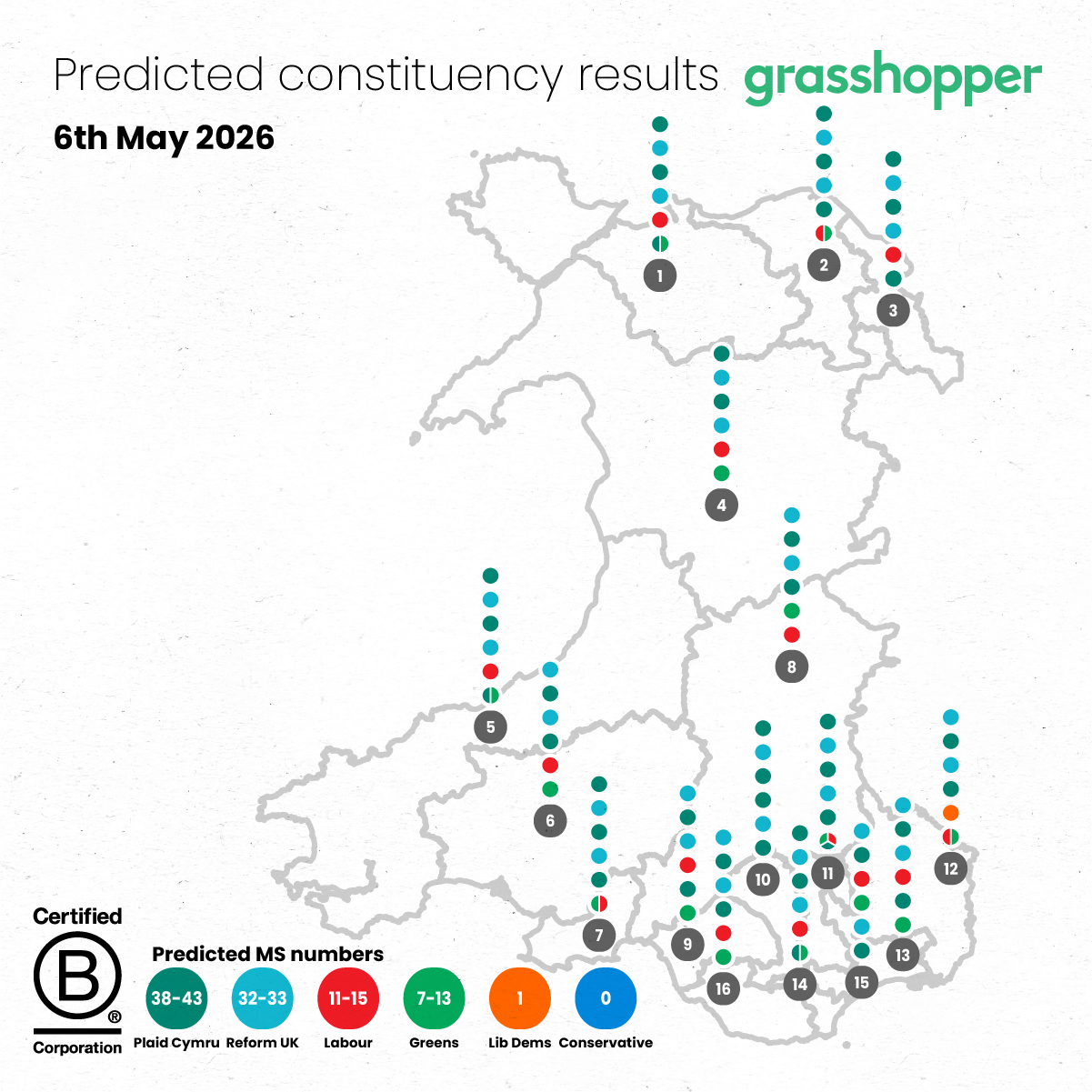
The latest Grasshopper analysis, based on aggregated polling and Monte Carlo constituency modelling, projects Plaid Cymru to win between 38 and 43 seats in the expanded 96-member Senedd.
Reform UK remains highly competitive and is projected to secure between 32 and 33 seats, but the latest analysis suggests Plaid’s support is currently translating more efficiently into seats across key battleground constituencies.
Labour, meanwhile, continues to face significant electoral pressure and is projected to return between 11 and 15 Members of the Senedd.
Key findings
- Plaid Cymru projected to win 38–43 seats
- Reform UK projected to win 32–33 seats
- Labour projected to secure 11–15 seats
- Greens projected to win between 7 and 13 seats
- Conservatives projected to fail to win representation
- Liberal Democrats projected to secure one seat
- No party currently projected to achieve an outright majority
The modelling indicates that the next Senedd remains highly fragmented, with coalition negotiations likely to determine the next Welsh Government.
Plaid gains advantage in seat efficiency
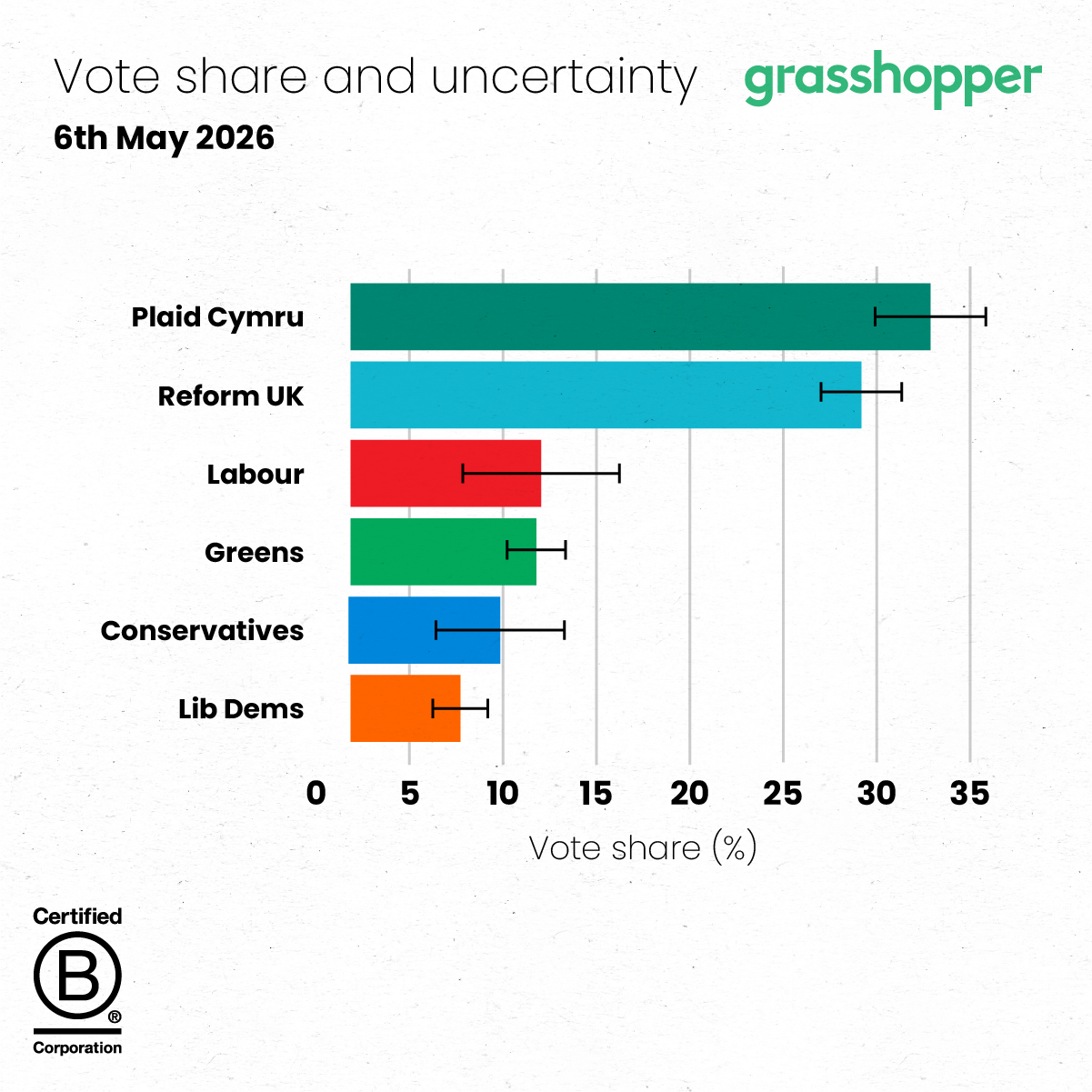
While Plaid Cymru and Reform UK remain relatively close in projected national vote share, the latest modelling suggests Plaid’s support is currently distributed more efficiently under the new electoral system.
Plaid Cymru is projected to receive around 33% of the vote, compared with approximately 29% for Reform UK.
However, constituency-level modelling suggests Plaid’s geographic concentration gives the party a stronger pathway to converting votes into seats across multiple regions.
Several constituencies remain highly competitive, particularly in South Wales, where relatively small vote shifts continue to have the potential to alter the final balance of power in the Senedd.
Reform UK remains competitive
Despite Plaid Cymru’s advantage in the latest modelling, Reform UK remains firmly within contention to emerge as the largest party.
The party continues to perform strongly across large parts of Wales and remains competitive in several battleground constituencies where margins are narrow.
The modelling suggests Reform’s support base remains highly resilient, particularly in areas where anti-establishment sentiment and dissatisfaction with traditional parties remain strong.
However, the latest analysis also suggests Reform may be approaching a ceiling in some areas where Plaid Cymru’s support is more deeply concentrated.
Labour faces continued pressure
The modelling presents a difficult picture for Labour, which continues to face pressure from multiple directions across Wales.
The party’s projected vote share remains substantially below historic levels, while uncertainty bands suggest outcomes could vary considerably between constituencies.
In several regions, Labour now faces simultaneous competition from Plaid Cymru, Reform UK, and the Greens, creating increasingly volatile electoral dynamics.
The Conservatives, meanwhile, are projected to struggle significantly under the new electoral system and are currently not forecast to secure representation in the Senedd.
Greens could still hold balance of power
The Greens continue to emerge as one of the most strategically significant parties in the race despite their comparatively modest vote share.
The latest modelling projects the party to win between 7 and 13 seats, potentially placing them in a pivotal position during any post-election coalition negotiations.
Even relatively small shifts in Green support could significantly alter the arithmetic required for government formation.
Craig Lawton said:
“The expanded Senedd and new voting system are creating a much more proportional and fragmented political environment.
“What matters now is not simply who tops the poll nationally, but how effectively parties convert support into seats across each constituency.
“At this stage, Plaid Cymru appears to have strengthened its position, but there are still multiple plausible pathways to coalition government.”
A highly uncertain race remains
Grasshopper’s modelling uses aggregated polling data alongside constituency-level demographic and electoral analysis to simulate thousands of possible election outcomes.
As with all polling analysis, the projections represent a snapshot of the race at the current time rather than a prediction of the final result.
With significant uncertainty remaining across several battleground constituencies, relatively small movements in public opinion could still reshape the final composition of the next Senedd in the months ahead.